

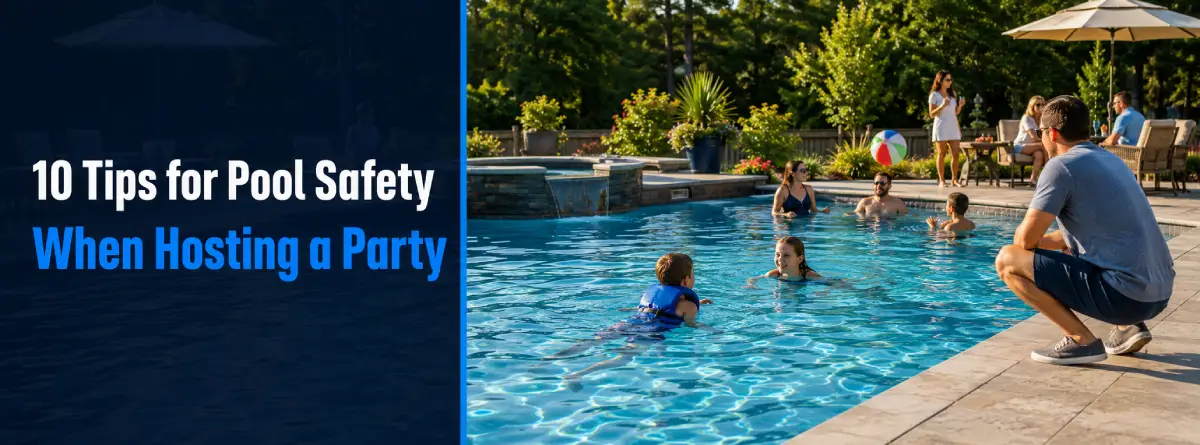
10 Tips for Pool Safety When Hosting a Party
A backyard pool party should feel relaxed, but the safety plan cannot be casual. Once guests arrive, adults start talking, food comes out, music gets louder, and it becomes surprisingly easy for everyone to assume somebody else is watching the water. Good pool party safety starts before the first guest walks through the gate. A few practical decisions can keep the day organized without making the gathering feel strict or uncomfortable.
The goal is not to remove the fun. It is to make sure the fun has a clear structure. These pool party safety tips are useful for family birthdays, neighborhood cookouts, graduation parties, and ordinary summer get-togethers around a home pool in Lexington, Columbia, or elsewhere in South Carolina.
1. Choose a Dedicated Water Watcher
The most important pool party safety step is assigning one responsible adult to watch the water. Do not assume that every adult is watching. In a crowded backyard, that usually means nobody has full responsibility.
The water watcher should stay close to the pool, keep eyes on the swimmers, and avoid phones, conversations, food preparation, and other distractions. Rotate the job among trusted adults so no one person becomes fatigued or loses focus. A simple fifteen or twenty-minute rotation works well for many parties.
For a large gathering, especially one with many children, hiring a trained lifeguard may be worth considering. Even then, parents and caregivers should continue paying attention to the children in their care. A lifeguard offers another layer of protection, not permission for every adult to stop watching.
2. Ask About Each Guest's Swimming Ability
Hosts often know which children are young, but they may not know who is comfortable in deep water. Before swimming starts, ask parents about each child's swimming ability, comfort level, and any medical concerns that could affect pool safety.
Do the same with adults when it makes sense. Some grown guests are weak swimmers, even if they do not say so right away. Others may become tired quickly or feel uneasy when they cannot touch the bottom. A quiet question is better than making assumptions.
Use that information to decide who needs closer supervision, a life jacket, or a clear limit on where they can swim. Swimming lessons help, but they do not replace active supervision. Strong swimmers can still become tired, injured, or disoriented during a busy party.
3. Explain the Pool Rules Before Swimming Begins
Pool rules work best when they are explained before anyone gets wet. Keep the list short enough that guests will remember it. Too many rules become background noise, while a few clear expectations are easier to follow.
- No running on the pool deck
- No pushing, rough play, or surprise dunking
- No diving unless the area is designed and marked for diving
- No swimming alone
- Ask an adult before entering the pool area
- Stay away from drains and suction openings
Say the rules out loud, even when they seem obvious. Children get excited, and adults can forget that a familiar pool may be completely new to a guest. A quick reminder sets the mood without turning the party into a lecture.
4. Keep Young Children and Weak Swimmers Close
Young children and inexperienced swimmers need more than someone watching from across the yard. A responsible adult should remain close enough to reach them immediately. That means being in the water or directly beside it, not sitting at a table several steps away.
This is one of the pool party safety tips that can feel inconvenient during a social event, but it matters. Drowning can be quiet and difficult to recognize. It does not always look like splashing, waving, or calling for help.
Do not let a crowded shallow end create a false sense of security. Children can slip, become trapped behind floats, or lose their footing. Keep the youngest guests within easy reach and limit the number of large floats in the water at any one time.
5. Use Real Life Jackets When They Are Needed
Inflatable rings, foam noodles, arm floats, and novelty rafts are toys. They are not substitutes for a properly fitted life jacket. For children and weak swimmers who need flotation support, use a Coast Guard-approved life jacket that fits the person's size and weight.
Check the straps before the swimmer enters the water. A loose life jacket can ride up around the face, while one that is too small may not provide the right support. The swimmer should still remain under active supervision.
Pool floats can also block the water watcher's view, especially when several oversized inflatables are crowded together. They are fun, honestly, but there is such a thing as too many. Leave sight lines open across the pool so every swimmer is visible.
6. Clear the Deck and Check the Pool Barriers
A safer pool party begins with a clean walking area. Move hoses, toys, cords, loose towels, coolers, and extra furniture away from the main path around the pool. Wet decks are already slippery, so clutter adds a problem that is easy to prevent.
Before guests arrive, test the gate and make sure it closes and latches properly. Doors leading from the house to the pool area should remain secured when not in use. Do not prop the gate open just because people are carrying food and supplies into the backyard.
Pool barriers, door alarms, and safety covers supply important layers of protection, but they still need adults to use them correctly. During the party, keep chairs, tables, and other climbable objects away from the fence.
7. Keep Glass and Alcohol Under Control
Glass should stay out of the pool area. A broken bottle or drinking glass can create a serious problem because clear fragments are difficult to see on a wet deck or underwater. Use plastic, paper, or other pool-friendly drinkware instead.
Alcohol also deserves a plan. Adults who are swimming or supervising children should avoid drinking. Alcohol can affect judgment, balance, reaction time, and coordination, which is a bad combination around water.
Set up the food and drink area a comfortable distance from the pool. This reduces spills, keeps traffic away from the edge, and gives guests a clear place to sit while eating. It also helps prevent someone from walking backward into the water while talking with a plate in hand, which happens more often than people expect.
8. Inspect the Water and Equipment Before the Party
Clear water is part of pool party safety because swimmers and supervising adults need to see the pool floor. If the water is cloudy, green, or difficult to see through, postpone swimming until the cause is corrected. A crowded pool is not the time to guess whether the water is safe and properly balanced.
Check the water level, circulation, sanitizer level, and general condition of the pool before guests arrive. Make sure drain covers are secure and in good condition. Children should be told not to sit on, touch, or play near drains and suction fittings.
Look over ladders, handrails, diving areas, steps, lighting, and nearby electrical equipment. If something is loose, damaged, or behaving strangely, keep that area closed until it is repaired. Pool party safety depends on the equipment working as expected, not simply looking fine from a distance.
9. Prepare for an Emergency Before You Need To
Keep a charged phone near the pool so emergency services can be called without searching through the house. Ensure the property address is easily visible and legible to emergency responders. Guests may know they are at your house, but that does not mean they know the exact street number.
A reaching pole and a ring buoy or other throwing device should be stored where adults can reach them quickly. These tools can help someone assist a swimmer without entering the water and creating another emergency.
At least one responsible adult should know CPR, and more is better. Review who will call for help, who will clear the pool, and who will guide responders to the backyard. Nobody likes thinking through that part of hosting, but a simple plan is much easier to follow than a panic.
10. End Swim Time Clearly and Secure the Pool
Pool party safety does not end when the organized swimming ends. In fact, the period after everyone gets out can be risky because adults relax, towels and toys cover the deck, and children may try to return to the water without permission.
Announce that swim time is over. Count the children, collect the toys, remove floats from the pool, and make sure every guest is accounted for. Empty small wading pools and water containers. Then close and latch the gate and secure any doors leading to the pool area.
Do not leave toys floating in the water after the party. A child may return to retrieve one. Cleaning up immediately also helps you see anything broken, missing, or left near the pool before the next swim.
A Safer Party Still Feels Like a Party
The best pool party safety plan is simple enough to follow while the backyard is busy. Assign a water watcher, know who can swim, keep young children close, use proper life jackets, reduce deck hazards, and prepare for emergencies. None of that ruins the mood. It actually gives everyone more room to enjoy the day.
